Historical Context
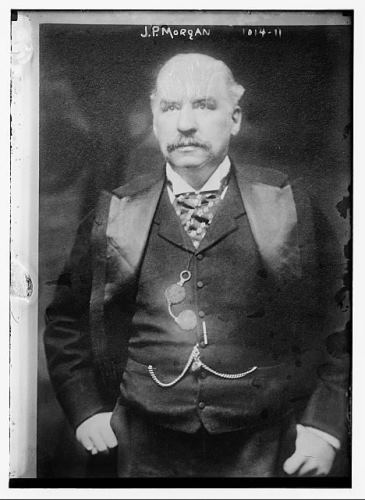
In October 1907, the United States had no central bank. There was no Federal Reserve, no government mechanism to inject liquidity into a failing financial system. When a wave of bank runs threatened to collapse New York's trust companies and bring the economy to a halt, one aging private citizen stepped into the vacuum — and held the line by sheer force of personality, calculation, and a locked door.
The cards felt cool in J. Pierpont Morgan's hands — old paper, worn silk backing. He laid them out on the mahogany table in his private study, each card a small negotiation with chance. Outside the study door, men were shouting. Outside, the city was burning through its last reserves of faith. But here, in the amber light of his library at midnight on November 3, Morgan played solitaire as though the world beyond these walls was someone else's problem.
His preferred game was Miss Milligan, a double-pack patience that required not luck so much as vision — the ability to see, three moves ahead, which cards must be held and which released. A man who could read the small mathematics of patience could read the larger mathematics of markets. And so, while forty trust company presidents argued in circles in the rooms beyond his study, Morgan turned cards and calculated. His mind was not idle. His mind was a weapon. And it was the only thing standing between the American economy and oblivion.
The bankers did not yet know the doors were locked.
The Copper That Broke a City
It had begun, as financial catastrophes so often do, with a man who believed he was smarter than the market.
F. Augustus Heinze had once been the king of Montana copper — a man who bent mountains to his will, who left school at sixteen and returned to Butte as an engineer-turned-titan by thirty. By the autumn of 1907, he was 38 years old and certain that his genius had only sharpened. On the New York Stock Exchange, surrounded by men he considered his inferiors, he would prove it. The scheme was elegant in its simplicity: corner United Copper Company stock. Buy enough shares to control the float, then force short sellers to purchase from him at whatever price he named. His confidence was absolute. What he didn't know was that October 14, 1907, would be the last day anyone would ever fear him.
By October 16, United Copper had collapsed from approximately $60 per share to $10. The shorts had found shares elsewhere. The corner had failed. Heinze was finished — but his failure was only the first domino.
The State Savings Bank of Butte, Montana, closely tied to Heinze's network, announced insolvency. Then came the press reports, the whispers, the connections drawn in the financial pages: Charles T. Barney, president of the Knickerbocker Trust Company — the third-largest trust in New York City — had been associated with Heinze's circle. Barney had not participated in the copper scheme. But in a panic, proximity is guilt enough.
On the morning of October 22, the run began.
"As fast as a depositor went out of the place ten people and more came asking for their money."
The New York Times, October 22, 1907
On the corner of Fifth Avenue and 34th Street, Mrs. Eleanor Pritchard stood in line outside the Knickerbocker's marble entrance. She had arrived before seven o'clock, her small reticule containing $400 — every penny she had saved over fifteen years of widow's work as a seamstress. The woman ahead of her wept silently. The woman behind her fanned herself, breathing in short gasps. By eight o'clock, the line stretched around the block. By nine, the police had been called to maintain order.
Eleanor's hands trembled. She had seen bank failures before, in the panic of '93. She knew how these ended. The teller's window would close. The doors would lock. And everything she had would be gone.
By noon, the Knickerbocker had paid out $8 million in three hours. The institution's vaults were hemorrhaging. At 12:30 in the afternoon, the bank suspended operations. The doors closed. Eleanor, standing in line with her $400, had been sixteen people from the window.
Charles T. Barney, forced to resign four days earlier, would be dead by suicide within three weeks. Eleanor Pritchard would live another forty years, renting rooms and working as a seamstress, her life a portrait of one woman's encounter with the invisible machinery of financial collapse.
Borough by Borough, the Runs Spread
The Knickerbocker was a domino. The question was how many would fall behind it.
That same evening — October 22 — Morgan convened a war council at his library: George F. Baker, president of First National Bank; James Stillman, president of National City Bank; and Treasury Secretary George B. Cortelyou, who had come from Washington with a federal checkbook and the willingness to use it. Cortelyou pledged to deposit government funds across New York's solvent banks. Morgan dispatched a young banker named Benjamin Strong to examine Knickerbocker's books and determine whether the trust could be saved.
Strong worked through the night and into the next day. His verdict was devastating: the trust's solvency was uncertain. Morgan made the calculation in seconds. To spend a single dollar on a failing institution was to rob a dollar from one that could survive. He declined to extend credit. He would let Knickerbocker fall.
It was the hardest decision of the crisis — and perhaps the right one. But the choice sent its own signal to a city already running on fear: No one is safe.
The runs moved like fire through a tenement block. The Trust Company of America, the second-largest trust in New York, began losing deposits on October 23. By day's end, it had lost $8 million. Morgan arranged an emergency loan of $8.25 million to keep it open. On October 24, the NYSE itself nearly collapsed — there was simply no cash left on the trading floor to settle transactions. Morgan convened bank presidents in his library, extracted pledges totaling $23.6 million, and kept the exchange open through the closing bell.
By the last week of October, the panic had spread across the boroughs. The First National Bank of Brooklyn, the Williamsburg Trust, the Borough Bank, the Jenkins Trust — all under pressure. Providence reported runs. Philadelphia reported runs. Pittsburgh reported runs. New York City itself, unable to sell its bonds in the collapsed market, was within weeks of defaulting on its own obligations.
On October 29, Morgan organized a syndicate to purchase $30 million in municipal bonds at par. He saved the city.
Washington stayed largely silent. President Theodore Roosevelt was deep in an antitrust philosophy that made him uncomfortable with Morgan's concentrated power. The Treasury secretary, for all his helpfulness, had no formal legal mechanism to inject capital at scale. The machinery of government watched from a distance as one man held the line.
The Solitaire General
By Saturday, November 2, a new crisis had surfaced: Moore & Schley, a prominent brokerage firm with $50 million in bonds issued by Tennessee Coal, Iron & Railroad, was near failure. Its collapse would drag other institutions with it — a cascade that would break the trust companies all over again. Morgan convened a Saturday morning conference. By that evening, he had summoned forty to fifty bankers to the library at 36th Street and Madison.
The scene that assembled inside the Morgan Library that night would have been, to any observer from the future, almost incomprehensible. In the East Room — lined with Flemish tapestries, Renaissance bronzes, and first editions from another century — clearinghouse bank presidents gathered around a long table. In the West Room, trust company executives occupied chairs arranged in formation. Morgan moved between rooms like a general surveying a battlefield. Then he withdrew to his study.
And played cards.

Jean Strouse, in her landmark biography, reconstructed the habit from contemporaneous accounts. The game was a form of discipline — not escape, but method. While forty trust presidents fought like children over whether to contribute $25 million they didn't have, Morgan turned cards and read patterns. His mind was not distracted. It was working.
Around midnight, the situation clarified. Morgan announced the amount: $25 million from the trust companies — not from the clearinghouse banks, who had already contributed. The trust presidents balked. The sum was enormous. They had not caused this crisis. Why should they pay to end it?
The conversation continued. The hours passed. Outside, the city slept. Inside, Morgan's library had become something else entirely: a pressure chamber, a negotiation, a test of will.
At some point — later accounts differ on exactly when — one of the trust company presidents moved toward the front door to leave. He was done. He had contributed what his conscience allowed. The others could negotiate themselves to hell.
He pulled on the brass door handle. Nothing happened. He pulled again, harder, his knuckles whitening against the metal. The door was locked. A moment of suspended silence spread through the adjoining rooms like a spill of water. One man turned to another. The word moved through the library in whispers: Locked. Morgan locked the door.
No one approached Morgan directly. No one needed to. The message was absolute: You do not leave this room until the work is finished.
Time had become a weapon. And Morgan knew how to use it.
As the hours passed — one o'clock, two o'clock, the darkness absolute outside the library windows — the bankers understood what was happening. Morgan had imprisoned them. The most powerful financial figures in America, trapped in a Renaissance palazzo at 36th Street while the clock moved toward morning. By three o'clock, some 120 bank and trust officials had assembled in those rooms, packed into salons lit by gas lamps and electric fixtures, the air growing thick with tobacco smoke and exhaustion.
By 3:15 AM, the windows of the Morgan Library had begun to show the first pale suggestion of dawn. Somewhere in the city, workers were already moving. The printing presses of newspapers were warming. In a few hours, the NYSE would open. If these men left this room without an agreement, thousands of telegrams would spread the news across the country before noon: The bankers have failed. Save yourself. Every run in every city would become a sprint toward oblivion.
Parallel to the trust company crisis, Morgan's associates were brokering the acquisition of Tennessee Coal, Iron & Railroad by U.S. Steel — a mechanism that would absorb Moore & Schley's debt and give the brokerage a path out of collapse. Emissaries reached President Roosevelt before dawn. They obtained his antitrust blessing before the NYSE opened for Monday trading.
Benjamin Strong, who had spent those weeks in what he later described as "the endless incidents, some tragic, some humorous, many of them exciting or depressing, which characterized those weeks of strain and anxiety," understood better than most what was happening in those rooms. One man was building, through sheer force of will, the rescue that governments could not or would not arrange.
At approximately 4:45 in the morning, Morgan walked into the room where the trust company presidents had spent hours refusing to sign. His face showed nothing. His voice showed nothing. He stated, simply, what was required: the amount, the deadline, the fact of the situation. Their unofficial leader signed. The others followed.
"Gentlemen, we will now sign" — the words widely attributed to Morgan in the aftermath, though the precise originating source has not been definitively confirmed. Whether he said them exactly or not, the meaning was the same: It is over. You have lost. I have won.
The Institution That Replaced the Man
The sun came up on November 4, 1907, and the crisis was effectively resolved. The runs slowed. Then stopped. The stock exchange did not collapse. New York City did not default. The panic that had threatened to become a depression subsided into recession, which ended by May 1908.
Charles T. Barney was already buried. Eleanor Pritchard returned to her seamstress work, her $400 lost forever. F. Augustus Heinze was ruined. And J. Pierpont Morgan, 70 years old, had single-handedly prevented the collapse of the American financial system.
That was the problem.
George Perkins, Morgan's own partner at J.P. Morgan & Co., put it plainly: "Mr. Morgan was able to do what he did in that panic because of the man and his personality, and because people believed in him." But what happened when the man was gone? What happened to the next panic, when there was no Morgan?
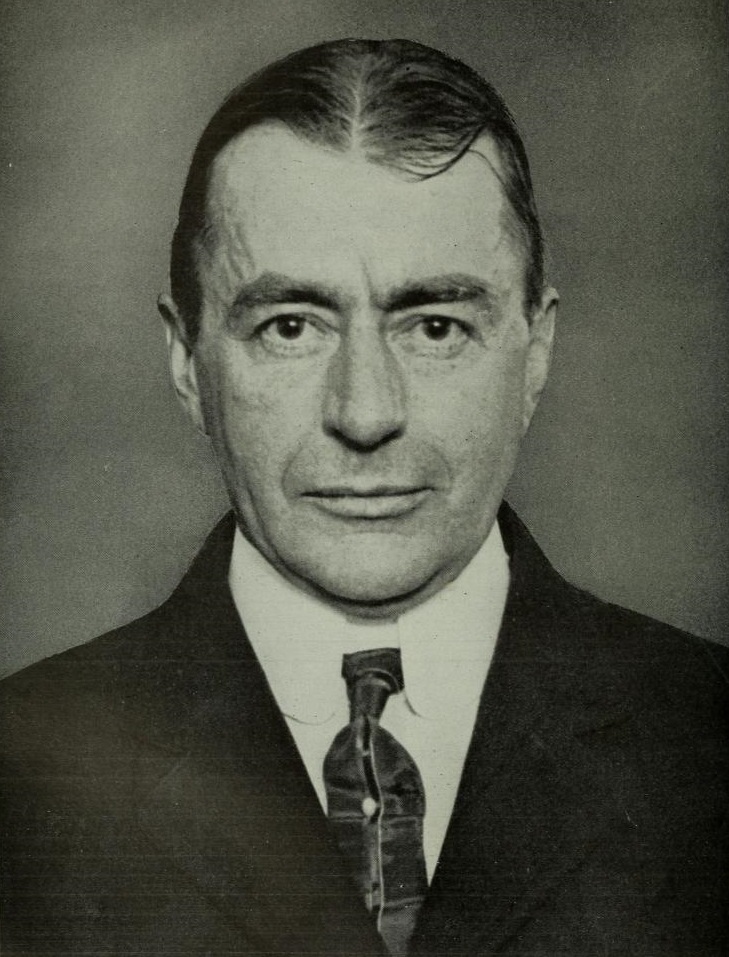
Jean Strouse captured the nation's response with equal precision: "The exercise of that much power by one private citizen horrified a nation of democrats and revived America's long-standing distrust of concentrated wealth." The Pujo Committee, investigating the money trust in 1912, would reveal that Morgan-affiliated officers sat on the boards of corporations representing $22.5 billion of the $26.5 billion total NYSE capitalization. The library at 36th Street had become visible as what it had always been: the operational center of American finance.
Congress drew the institutional conclusion. In November 1910, a secret gathering on Jekyll Island, Georgia — Senator Nelson Aldrich, Paul Warburg, Frank Vanderlip, and Benjamin Strong among them — drafted the framework for a central bank. Strong, who had spent those sleepless weeks in 1907 watching Morgan hold the system together by force of personality alone, became the first Governor of the Federal Reserve Bank of New York, the institution's dominant voice until his death in 1928.
On December 23, 1913, President Woodrow Wilson signed the Federal Reserve Act into law.
By then, the key was no longer in any man's pocket. It had been forged into law. The Morgan Library's carved ceilings would remain — a reminder of the moment when private power saved the republic it was not meant to save, and forced the nation to finally build the institutions that could. The locked library door was the argument. The Federal Reserve was the answer. One private citizen should never again need to pocket that key.
Eleanor Pritchard is a composite figure drawn from documented contemporaneous accounts of depositor runs, used here to give human scale to abstract financial data. All financial figures, dates, names, and institutional details are drawn from the sources listed below. The scene of the locked door is reconstructed from multiple historical accounts, none of which agree precisely on timing; the sequence presented here follows the reconstruction in Strouse (2000). The attribution "Gentlemen, we will now sign" appears in American Heritage (1957) citing Satterlee; its precise origin has not been independently confirmed.
Sources: Jean Strouse, Morgan: American Financier (Random House, 2000); Federal Reserve Bank of New York, Liberty Street Economics (Nov 2016); Federal Reserve History (federalreservehistory.org); Herbert L. Satterlee, cited in American Heritage, "A Lion in the Street" (June 1957); Morgan Library & Museum Stop 23 audio guide; Gotham Center for NYC History; Wikipedia, Panic of 1907; George Perkins, cited in American Heritage (1957).


