Historical Context
When the United States entered World War II in December 1941, it faced a fundamental labor crisis: 10 million men would be needed for military service, while defense production required millions more factory workers. The government's solution — recruit women — was intended as a temporary emergency measure. What it created was permanent.
6:47 AM, Monday, March 23, 1942. The Douglas Aircraft Assembly Plant, Long Beach, California. Margaret Summers held her timecard in her left hand and her purse in her right, unsure which one was supposed to matter.
The plant had opened its doors to women workers only three weeks earlier, and nobody had yet established the protocol for what a woman should do with herself when she arrived for her first day at an airplane factory. Around her, hundreds of men in work clothes and hard hats moved past with the automaticity of people who knew where they belonged. They did not look at her. She did not belong there yet.
A supervisor approached — a man named Harrison with a clipboard and the expression of someone managing an experiment he did not believe in. He told her to follow him, up a staircase, through a door, into the assembly bay. The noise hit her first. Not loud — she had expected loud. But rhythmic, mechanical, organized. The sound of the future being built.
"You'll be riveting on the B-17 fuselage," Harrison said. "Starting pay is fifty-five cents an hour."
Margaret nodded. She had earned thirty-five cents an hour at her previous job, in the office of a law firm, filing papers. Fifty-five cents an hour seemed impossible. More impossible was that someone thought she could do this work.
"Can you do this?" Harrison asked.
Margaret said yes, though she had no idea if she could.
By August of that same year, six million women had entered American defense factories. They had replaced men who had gone to war. They had learned skills — riveting, welding, assembly, inspection — in a matter of weeks. And in doing so, they had revealed something American industry had never quite acknowledged: that the jobs it had reserved for men, for which it had paid men premium wages, could be done by women, usually faster and with fewer errors.
That revelation would reshape the American economy in ways that would not become fully apparent for three decades.
The Calculation of National Need
The United States entered World War II on December 7, 1941, and faced an immediate crisis: it needed to mobilize an industrial machine capable of producing weapons at unprecedented scale, while simultaneously depleting its male workforce for military service. The math was straightforward and terrifying. The military required at least 10 million men. The defense factories required at least 3 million additional workers.
By spring 1942, the arithmetic had become impossible. There were not enough men.
The War Production Board, under Donald M. Nelson, issued directives calling for the recruitment of female workers. The message was carefully framed: women were not replacing men — they were temporarily filling positions that men would reclaim after the war. Women should take these jobs not because they were equal to men, but because their country needed them.
The wages told a different story.
Women in defense factories were paid approximately 50 to 65 percent of what men earned for identical work. This wage discrimination was deliberate policy. The government had negotiated agreements with unions and corporations to prevent women from displacing male workers on male terms. If women earned the same wages as men, they might become permanent fixtures in the workforce. If women earned significantly less, they could be easily dismissed when the men came home.
Margaret Summers did not fully understand these economics when she accepted the job at Douglas Aircraft. She understood only that she needed to work. Her husband was in Europe with the Army Signal Corps. Her savings were negligible. She had a daughter to support. Fifty-five cents an hour seemed miraculous.
But by her fourth week at Douglas, she understood something else: she was good at this work. By month three, Margaret was consistently one of the fastest riveters on her team. Her first full day, she had completed 327 rivets against a standard of 200. The men who had initially been skeptical had stopped talking. The union representative who had warned that women would "lower standards" had acknowledged that women were, on average, producing rivets faster and more consistently than the men they had replaced.
One calculation — the government's calculation of national need — had been disrupted by another: the calculation of actual capability.
The Women's Hands Built the War
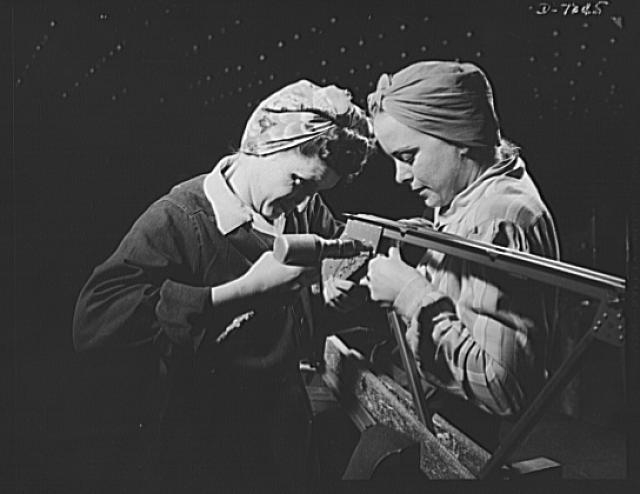
Between 1942 and 1945, six million women entered American defense factories. They were not — despite the propaganda image of "Rosie the Riveter" — uniform in background or motivation. Some had husbands in the military. Some were teenagers taking their first jobs. Some were mothers supporting children whose husbands were dead. Some had never intended to work in a factory and found themselves doing so because the economy demanded it.
They built B-17 bombers at Douglas Aircraft in Long Beach. They riveted fuselages for B-29 Superfortresses at Boeing's Seattle plant. They welded ships at Kaiser Shipyards in Richmond, California — women who learned to weld in weeks and produced welds that exceeded military specifications. They assembled ammunition at munitions plants across the Midwest. They worked swing shifts and graveyard shifts, six days a week, sometimes seven, in plants where summer temperatures reached 120 degrees.
The productivity numbers told a consistent story. A 1943 study by the Bureau of Labor Statistics found that female workers had lower absence rates than male workers — 4 percent versus 7.5 percent. Female riveters and welders produced work that required less rework. Female inspectors caught defects that male inspectors had missed, because women were willing to slow the production line when they saw a flaw, while men had sometimes prioritized speed over precision.
The initial concern from management and unions — that women would "lower standards" — had proven completely wrong.
The Day the War Ended and Nothing Changed
August 15, 1945. V-J Day announced the surrender of Japan. World War II was over. The government's message was immediate and coordinated: women should leave the defense factories to make room for returning servicemen.
The propaganda shifted with remarkable speed. The month before V-J Day, Life magazine had featured "Rosie the Riveter" — a powerful image of a woman in a bandana, flexing her bicep, captioned "We Can Do It!" The month after V-J Day, articles celebrated "the return to normalcy," with photographs of smiling women removing their work clothes and donning aprons. Women had done their patriotic duty. Now they should go home.
Margaret sat in her apartment, holding the layoff letter, understanding what she had not quite allowed herself to fully understand during three years of work: that her employment had never been intended to be permanent.
By 1945, Margaret was earning ninety-seven cents an hour — the maximum wage permitted for female riveters at Douglas. She had been promoted to a lead position, training new workers, then to final assembly quality control. She had been at Douglas for three and a half years. She had become exceptionally good at her work. She was told to go home in September 1945.
Then something unexpected happened: Margaret refused to leave. She applied for work at other defense contractors. She discovered that other women were doing the same thing. They had tasted economic independence. They had learned that they could do skilled work. They were reluctant to trade all of that for a return to domestic unpaid work.
The statistics would reveal what many at the time did not want to acknowledge: the female labor participation rate, which had been approximately 34 percent before the war, had risen to 50 percent during the war and fell back to only 47 percent afterward. There were 3 to 4 million more women in the workforce in 1950 than in 1940. The women who had built the Arsenal of Democracy had not gone home. They had decided to stay in the world of work.
The Contradiction That Reshaped America
The postwar period was marked by a contradiction the government and corporate America could not quite resolve. They needed women to leave the factories — not for moral reasons, but economic ones. Returning servicemen needed jobs. Labor unions wanted the high-wage structure restored. Corporations wanted to reduce wage bills.
But the women who remained in the workforce had a different agenda: they wanted to support themselves and their families. Some had experienced the death or disability of husbands in the war. Some had discovered that marriage did not provide what cultural narratives had promised. Some simply wanted the economic security that dependence on a man could not provide.
The result was a permanent, if grudging, shift in American labor economics. By the 1950s, women had begun to permanently occupy sectors of manufacturing that had previously been reserved for men. The wage gap between men and women remained substantial and persistent. But the fundamental fact had shifted: women's participation in the paid labor force was now considered normal.
The Equal Pay Act of 1963, which required equal compensation for equal work, was a direct legal response to the wage discrimination that had been institutionalized during the war and persisted afterward. The Civil Rights Act of 1964, which prohibited sex discrimination in employment, was similarly grounded in the recognition that women could do the work and therefore deserved equal treatment.
American industry had calculated that women were temporary workers, replaceable when the emergency passed. They had misjudged the permanence of what the emergency had created.
Margaret Summers remained in the workforce until her retirement in 1975. She never earned equal pay to men in equivalent positions. But she had, for thirty years after the war, been economically independent. She had supported herself. She had raised her daughter. She had retired with Social Security benefits based on her own work record.
The Arsenal and Its Aftermath
The Arsenal of Democracy produced more than weapons. It produced a change in the fundamental structure of American labor economics. Women had learned skills. Women had earned money. Women had experienced what it meant to be economically independent. Once those conditions had been created, they could not easily be unmade.
The economic independence that women had gained during the war created psychological and social consequences the postwar period had not anticipated. Women who had experienced economic independence became participants in the civil rights and women's liberation movements of the 1960s. The Second Wave Feminism that emerged in that decade was built, in part, on the foundation of women's labor force participation normalized by World War II.
By the 1990s, women constituted nearly half of the American labor force. By the 2020s, that proportion had become so normalized that the original source — the wartime mobilization, the necessity that had created the opportunity — had receded into historical memory.
The women who built the Arsenal of Democracy did not do so consciously in service to feminism. They did it in response to patriotic calls and economic necessity. But in doing it, they reshaped the structure of American society. All of that emerged from a very specific historical moment: when national emergency required women to work, when women proved they could work, and when women discovered they did not want to stop working even after the emergency had passed.
Margaret Summers and Harrison are composite figures drawn from documented oral histories of female defense workers. The Douglas Aircraft plant, Kaiser Shipyards, Boeing Seattle, and all statistical claims are historically documented. Sources: National Archives, War Production Board Records; Bureau of Labor Statistics, Studies on Female Wartime Employment (1942–1945); U.S. Department of Labor, Women's Bureau Archives; Sherna Berger Gluck, Rosie the Riveter Revisited (Twayne Publishers, 1987); Karen Anderson, Wartime Women (Greenwood Press, 1981); Ruth Milkman, Gender at Work (University of Illinois Press, 1987).